The Microstructure of Markets: How Order Books Actually Work
This piece is the first edition of a series that aims to unpack the market microstructure behind modern trading, showing how Order Books drive price discovery, liquidity formation, and execution dynamics. It explores how matching logic, latency design, and incentive structures shape fairness and stability - linking the technical architecture of exchanges with the real-time behavior of markets.


0xniko0x
1/5/2026
First Thing's First
Limit order books (LOBs) power modern exchanges by listing all active buy and sell orders in real time, giving traders a transparent view of supply, demand, and liquidity. Central limit order books (CLOBs) dominate because they unify all this information into one shared, fair marketplace where orders are matched by clear price-time rules, enabling efficient price discovery, low trading costs, and deep liquidity. Whether in pure LOB markets like Hong Kong and Tokyo or hybrid models like NYSE and NASDAQ, today’s technology lets traders watch order-book depth live - making LOBs the foundation of how markets form prices and execute trades.
At the core limit order book is simply a constantly updating list of bids and asks. Buyers post the price they want to pay; sellers post the price they want to receive. When those two sides match, a trade happens - and that traded price becomes the new market price. Every price tick is just buyers and sellers meeting in real time.
At a fundamental level, the order book is simple. Its complexity emerges from how participants interact with it.
LOBs offer practical advantages:
- improving order execution
- minimizing market impact
- designing better trading algorithms
- and assessing overall market stability
Understanding market microstructure is key - markets move because orders interact, not because time passes. Market orders consume liquidity, limit orders supply it, and trigger orders can accelerate volatility when many activate at once. High frequency traders (HFT) liquidity providers, and institutional routing, all influence how well this flow is absorbed.
But ultimately, every price change comes from the real-time collision of supply and demand inside the order book.
Liquidity and Market Depth
Liquidity describes how easily an asset can be bought or sold without causing significant changes in its price. It reflects the market’s capacity to absorb trades, and is one of the most critical indicators of market health and efficiency.
Liquidity is best understood through two core components:
- Spread: the difference between the best bid (highest buyer) and the best ask (lowest seller), represents the immediate transactional cost of trading. Tight spreads indicate a highly competitive market with many active participants.
- Depth: defines how much buy or sell pressure the market can absorb before price moves. Deep markets can take size with little slippage; shallow markets move violently even on small flow. This is why large players rarely blast size directly through the book. They route block trades through OTC, RFQ, or private liquidity streams to avoid sweeping levels. In many cases, those channels actually produce better pricing and lower market impact than executing the same size on-exchange.
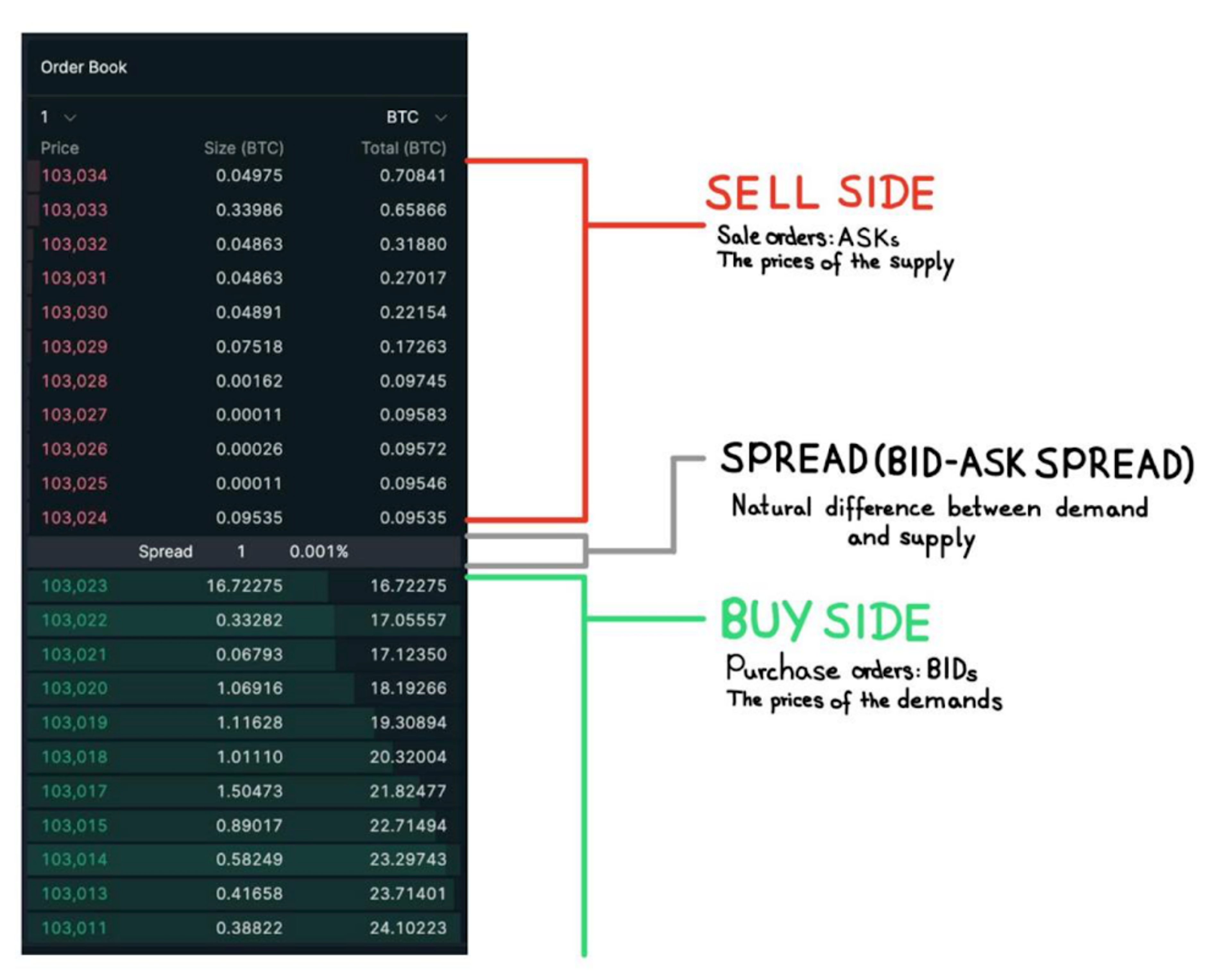
For top assets like BTC, ETH, and SOL, spreads usually stay tight because market makers and high frequency traders compete across multiple venues - and cross-exchange arbitrage constantly forces prices back into alignment, creating a unified global price even though liquidity is fragmented. But depth is not consistent everywhere, the visible book is only a snapshot of a certain moment - not a guarantee that depth will remain when price actually reaches certain levels.
How Liquidity depth is reflected in Orderbooks
An Order Book view provides a real-time visualization of liquidity. It shows resting limit orders on both sides - bids and asks - and updates dynamically as market orders interact with those levels. Traders use depth of market (DOM) data to analyze how liquidity behaves in response to price action:
- Resting orders represent passive liquidity waiting to be filled
- Market orders consume that liquidity, moving the price as they execute
- Watching how orders appear, disappear, or refill reveals the intentions of active participants and potential liquidity inflows/outflows
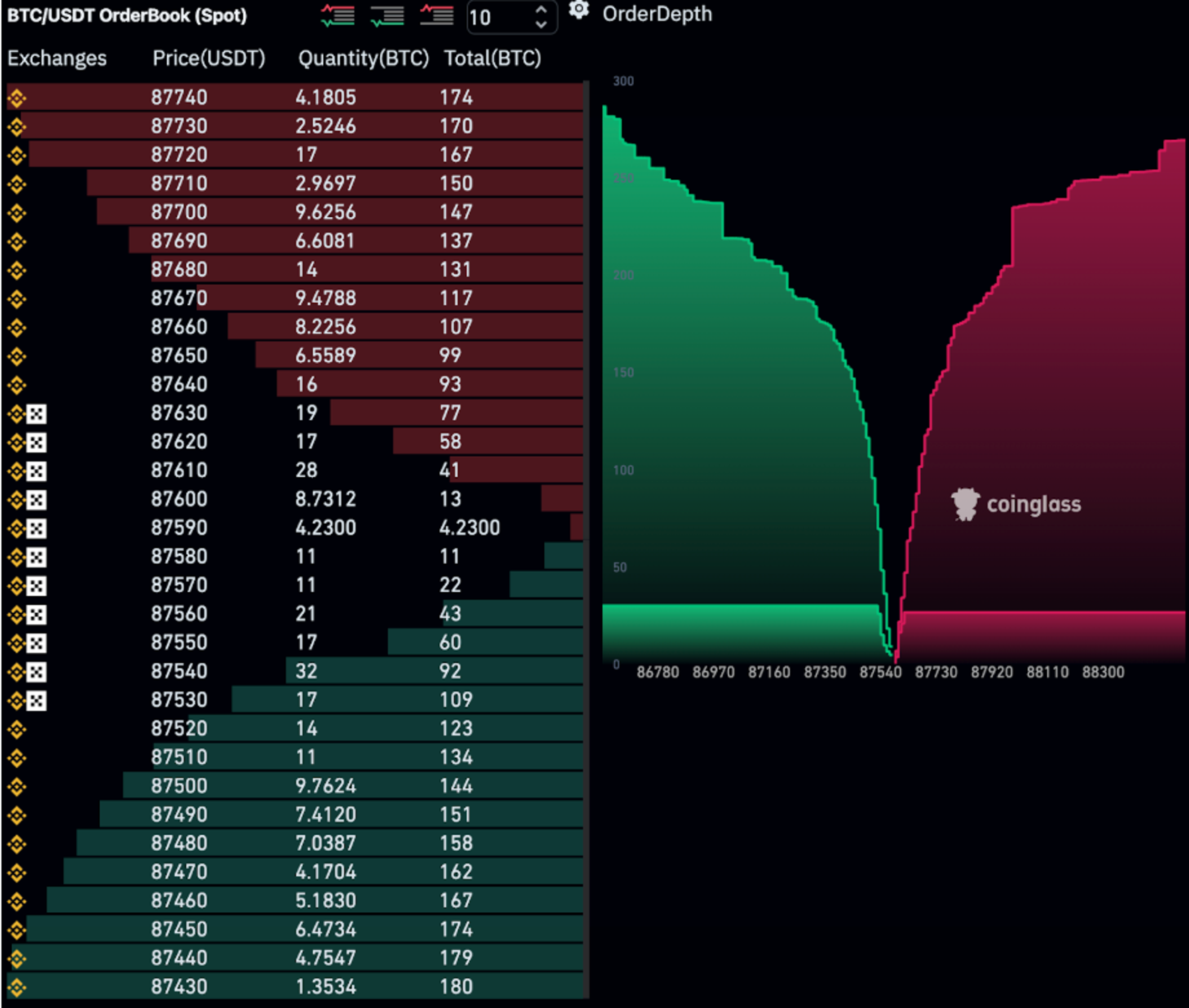
This visual combines an order book view with a depth chart. The depth curves help identify where liquidity is concentrated, where liquidity walls form, and where price is likely to react with increased volatility. Think of it as a macro-level view of market pressure.
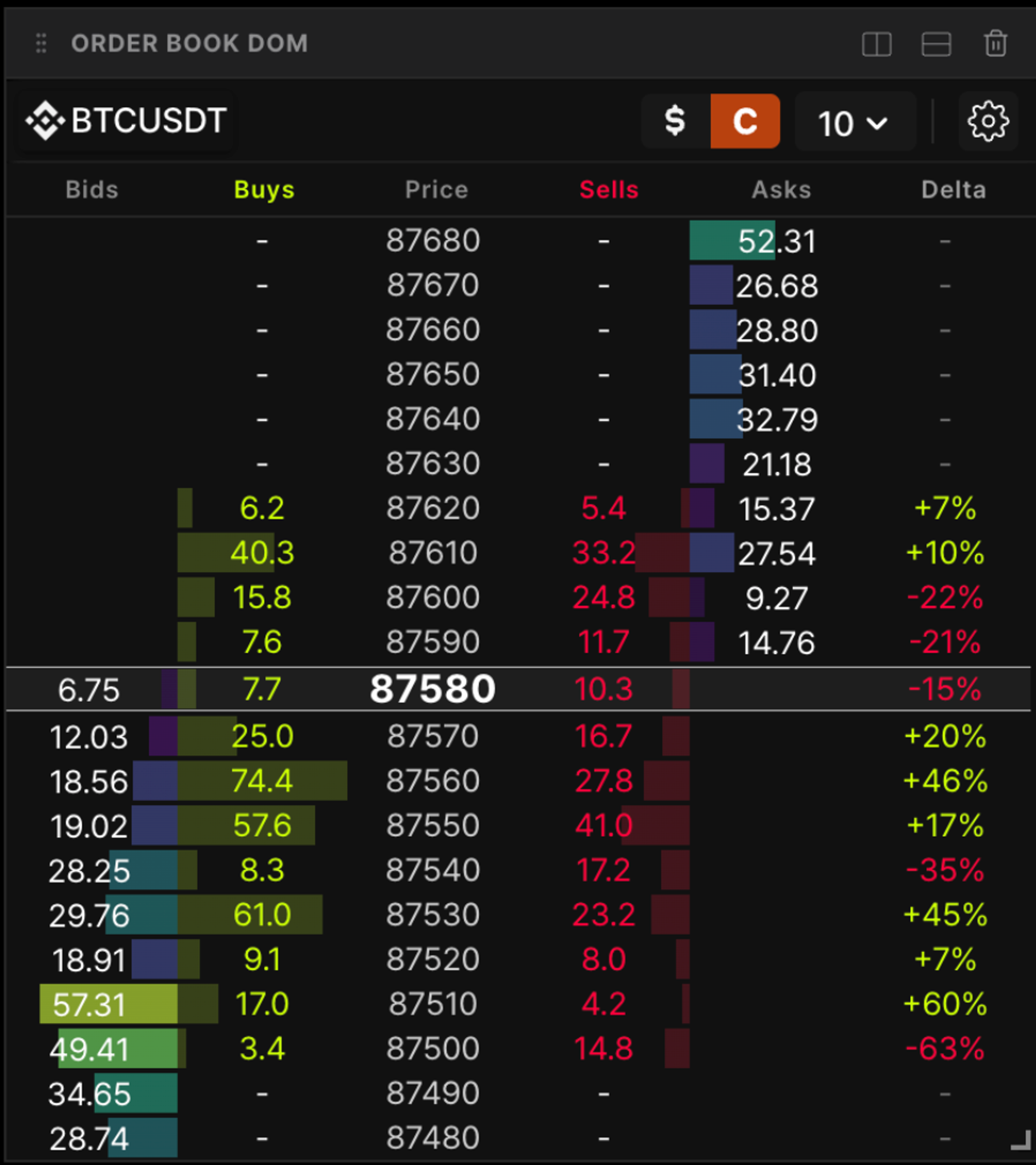
This second image shows the Order Book DOM, displaying raw order by order depth at each price level. It highlights bid and ask quantities, revealing buying vs. selling pressure, delta imbalances, and aggressive activity (in both directions) near the current price. This view is ideal for scalping, spotting spoofing or aggressive absorption, and taking accurate real-time decisions - a true micro, pro-trader focused view.
When large orders appear suddenly and then disappear, it can signal spoofing or liquidity being pulled before a move. When volume keeps refilling at a level in small chunks, it often signals an iceberg - large size orders hidden behind smaller visible ones. Because crypto liquidity is fragmented across many venues, professionals monitor aggregated books across exchanges, not just one. This gives a better read on global depth and highlights cross-exchange arbitrage windows.
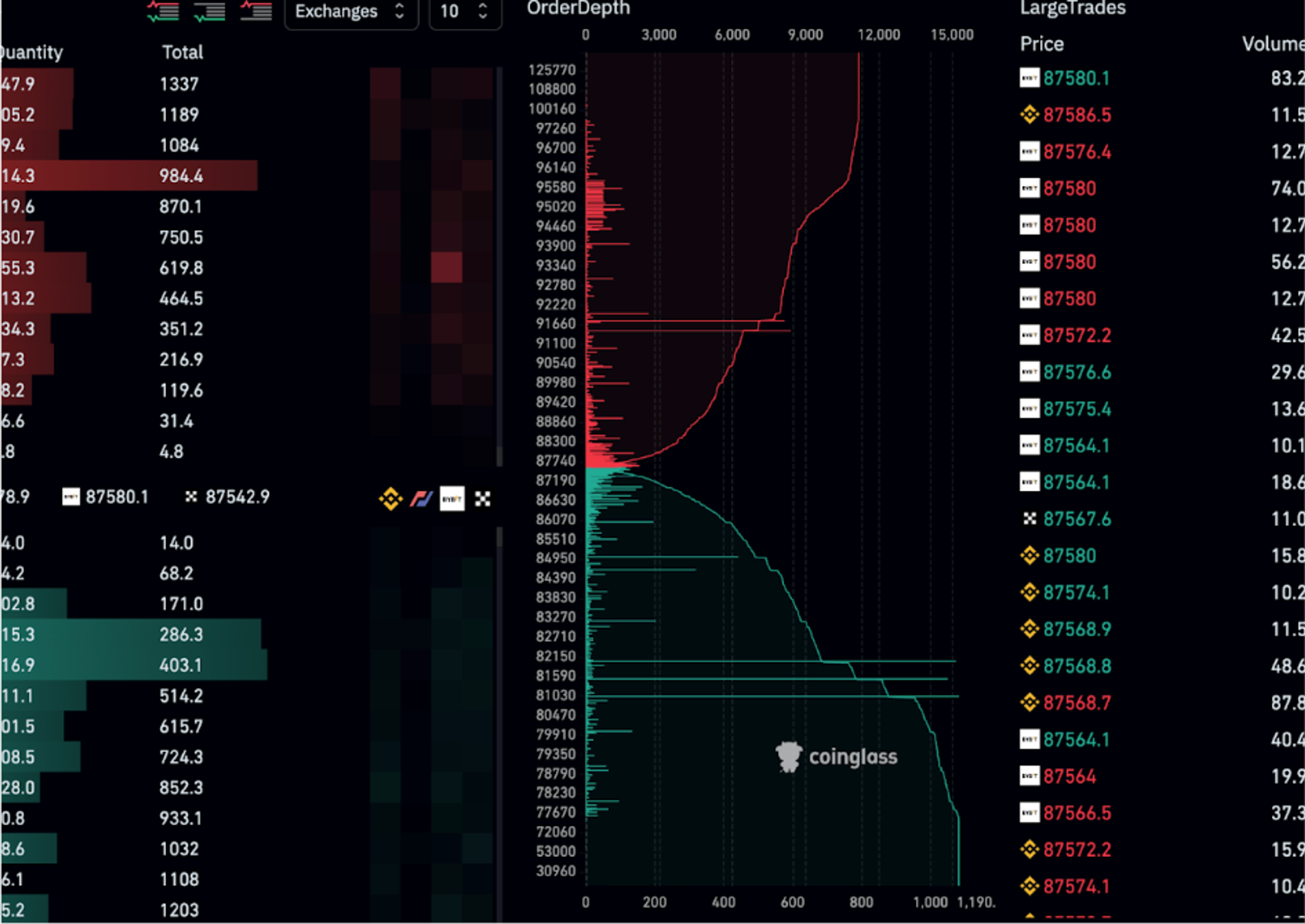
The visual above shows both the raw limit order book and the cumulative depth curve:
- red represents the sell side stacked above current price
- green represents the buy side stacked below
Notice how the depth curves bend outward - the steeper and further they extend, the more liquidity is resting at those levels. This tells you not just where liquidity is, but how hard or easy it is to move price.
Here, the red side (sellers) above price is much thinner further out, meaning it would take significantly more size to push price lower once you climb into those zones. The green side is also deep below, but thinner than the red above at further distance. This shows asymmetry in risk/pressure the path of least resistance is not symmetrical in both directions. However, the order book shows only intent, not commitment. Liquidity only becomes real when it meets aggressive flow.
AMMs vs CLOBs - Structural Tradeoffs
For crypto-native markets, it’s also important to understand why Central Limit Order Books (CLOBs) tend to outperform Automated Market Makers (AMMs) once sufficient liquidity and market participation exist. AMMs are fundamentally passive systems: liquidity sits statically in pools and prices adjust mechanically as trades flow through them. This makes them simple, permissionless, and ideal for bootstrapping new or illiquid assets - but also structurally inefficient under heavy or informed/toxic flow.
In practice, AMMs are often arbitraged by CLOBs, with professional traders using centralized or off-chain order books to correct AMM pricing and extract mispricings. Many advanced strategies even attempt to mimic CLOB behavior on AMMs through techniques like just-in-time (JIT) liquidity, dynamically placing liquidity only when trades occur. While effective to a degree, these are approximations of the continuous price discovery and adaptive liquidity that true order books provide. AMMs excel at accessibility and early liquidity formation; CLOBs take over at efficient price discovery once markets mature.
Order Book Engineering and Performance
Behind every active exchange lies a matching engine - a high-performance software system responsible for processing thousands of transactions per second with precision and fairness. The matching engine is the core component that determines how efficiently an exchange operates, how quickly it reacts to market events, and how transparently it executes trades.
To understand how this system works, it helps to break down the main components of an exchange and the logic that governs how orders are handled.
A typical exchange architecture consists of three primary subsystems:
- Trading System: This is the execution layer that accepts, matches, and processes orders. It manages order placement, trade execution, and trade confirmations.
- Market Information System: This subsystem disseminates real-time market data - including price updates, trade volume, and order book depth - to participants.
- Clearing and Settlement System: Once trades are executed, this layer handles post-trade settlement, ensuring that assets and payments are transferred securely between counterparties.
Order Execution Logic
Every exchange follows a defined set of execution rules to ensure fairness and consistency. These rules determine which orders are executed first when multiple orders compete at similar prices.
Traditional Finance (TradFi) Execution
In traditional markets, order execution typically follows two key principles:
- Price Priority: The best-priced orders are matched first - the highest bid (buy order) and the lowest ask (sell order) take precedence.
- Time Priority: If multiple orders exist at the same price level, the order that arrived first gets executed before the others.
This price/time priority model rewards participants who both quote competitive prices and react quickly, balancing liquidity provision with execution fairness.
Decentralized Finance (DeFi) Execution Models
In DeFi, execution logic differs significantly because matching happens onchain, and transactions are processed according to blockchain sequencing, not centralized time stamps. There are three main models that govern how orders are sequenced and executed in onchain environments:
- First-Come, First-Served (FCFS): The earliest valid transaction is executed first, regardless of price
- Order-Type Batch Sequencing: In this model, orders are grouped and sequenced within short time windows - often aligned with block times
- Priority Gas Auction (PGA): Common in EVM based systems, this model orders transactions by gas price - the higher the fee attached to a transaction, the earlier it’s included in a block
Performance and Fairness
A matching engine based on FCFS sequencing prioritizes fairness by arrival order rather than strict price optimization. Its performance depends on how effectively it can record, order, and process transactions in real time. Achieving low latency, deterministic sequencing, and transparent execution is crucial - especially in DeFi systems, where all state updates must be validated across the network.
In short, the engineering performance of an order book defines how efficiently markets operate. Whether centralized or decentralized, every exchange relies on its matching engine to maintain fairness, preserve market integrity, and enable smooth, continuous price discovery in a high-speed environment.
Timing, Latency Mechanisms & Adverse Selection Mitigation
Modern markets operate at microsecond speed, where tiny latency edges decide who captures opportunity. To preserve fairness and protect liquidity providers from adverse selection, both traditional and on-chain venues use timing and latency controls.
These mechanisms govern how fast orders can interact with the book, limiting ultra-fast participants from dominating purely through speed.
- Speed bumps: In TradFi, speed bumps add tiny delays before orders hit the book, which reduces latency arbitrage and protects passive liquidity. On-chain, block times behave like a macro version of this - state only updates in discrete batches. Hyperliquid for example queues transactions for ~3 blocks before settlement. Since cancel’s are prioritized, makers (especially validators) can adjust quotes before execution. This gives them natural protection and lets them quote tighter spreads without being instantly sniped.
- Frequent Batch Auctions (FBA): FBAs replace continuous trading with short discrete windows where all orders clear at one price. This removes microsecond speed races and shifts competition toward quoting the best price. DeFi versions (like CoW Swap) use this to reduce MEV/front-running. The trade-off: liquidity is only refreshed each batch, so the market can’t react as instantly as continuous order books.
- Randomized Delay Windows: Randomized delays add small, unpredictable timing variance, making execution order harder to game and reducing front-running. They’re increasingly used in MEV research and on-chain design, with the trade-off of less deterministic sequencing.
Fee and Incentive Structures
Market makers respond to incentives. Exchange fee + incentive design is the primary mechanism that determines where liquidity forms.
In crypto this goes way beyond public fee schedules - token rebates, airdrop farming, yield, and private MM deals often matter more than the base fee itself. On top of this, major MMs frequently negotiate private benefits (custom fee tiers, routing priority, credit lines, inventory financing, volume-based kickbacks) which never appear in public schedules. This creates asymmetric advantage and determines where real liquidity concentrates.
Liquidity is engineered - not neutral.
- Maker-Taker Pricing Model: Maker-Taker is the dominant fee model in TradFi & crypto exchanges. Makers (posting limit order) get small rebates (e.g. 0.01%). Takers (hitting / crossing spread) pay fees (e.g. 0.05%). This drives tighter quoting, deeper books, lower slippage, and more resilient execution during times of volatility. However, a downside of this is rebates distort true execution cost, create rebate-arb surface area, and incentivize HFT order spam/cancel behaviour.
- Zero-Fee trading: Feeless trading venues like Lighter.xyz remove direct transaction costs but generate revenue through wider spreads and API access for MM and HFT. As a result, front end traders avoid explicit fees yet ultimately incur costs indirectly through less efficient pricing and slippage. On the other hand, exchanges such as Hyperliquid impose some of the highest explicit fees in the market but consistently provide exceptionally tight spreads. This structure appeals to professional participants who prioritize execution quality, as higher upfront fees can translate into lower slippage and more efficient overall trade performance.
Why do those incentives and structures matter?
Applying these fee and incentive practices to DeFi and on-chain trading venues reveals key differences between centralized and decentralized market structures. CEXs primarily use Maker-Taker models to reward liquidity providers and attract market depth. High-volume market makers often negotiate custom rebate tiers, sometimes even achieving net positive payouts for providing liquidity. Many platforms also use VIP-tier systems that dynamically adjust both maker and taker fees based on trading volume or account status.
In contrast, DEXs operate under slightly different constraints, so traditional fee models don’t always translate directly. Emerging on-chain orderbook protocols are now experimenting with rebate-style incentives, gas-fee offsets, gasless order placement and cancellation, and token-based rewards to replicate Maker-Taker dynamics while maintaining decentralization and transparency. These innovations aim to attract professional liquidity providers and improve market depth without compromising the open, permissionless nature of DeFi trading.
Conclusion
At its core, the limit order book is the engine where technology, incentives, and human behavior converge to form price. Every update reflects a negotiation between makers and takers, shaped by latency, structure, and strategic intent. Price is not an abstraction - it is the outcome of these micro-interactions unfolding in real time.
Understanding market microstructure means understanding why markets behave the way they do under different conditions. Liquidity, volatility, and execution quality are not random; they emerge from how systems are designed and how participants respond to those designs.
This piece lays the foundation by explaining how orderbooks function and how liquidity forms and dissolves. The following pieces will build on this framework, exploring how volatility, adverse selection, and market design shape trading outcomes across both centralized and decentralized markets.


